
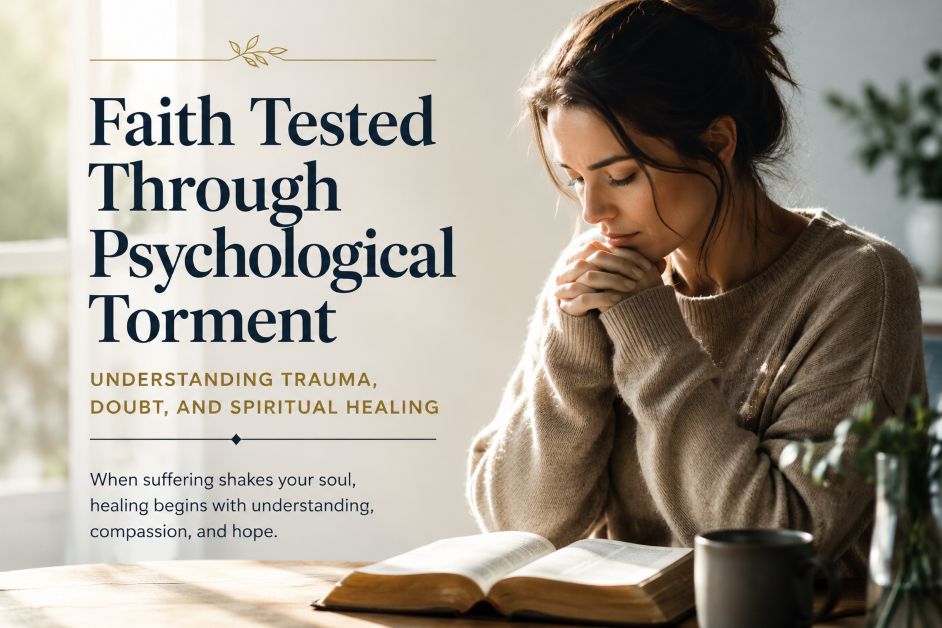
What happens when psychological pain becomes so intense that it begins to affect what you believe, how you pray, and how you understand yourself? A person experiencing faith tested through psychological torment may feel confused, exhausted, fearful, or spiritually distant. They may wonder why does trauma make me question my faith, or why does suffering make me question God when faith once provided comfort.
These experiences can be deeply unsettling. Psychological trauma and spirituality can become intertwined when fear, grief, emotional abuse, manipulation, or prolonged distress change the way someone understands safety and trust.
It is important to recognize that doubt is not automatically a sign of weak faith. Likewise, experiencing emotional distress does not necessarily mean someone has abandoned their beliefs. Sometimes psychological torment and faith intersect because a person is trying to make sense of an experience that feels overwhelming.
Understanding how trauma changes your relationship with God, recognizing the difference between a faith crisis and religious trauma, and learning how to rebuild faith after trauma can create a more compassionate path toward emotional healing and spiritual healing.
What Does “Faith Tested Through Psychological Torment” Mean?
Psychological torment describes prolonged or intense emotional distress that can affect thoughts, emotions, relationships, identity, and a person’s sense of safety. It can arise from emotional trauma, manipulation, abuse, grief, betrayal, chronic fear, or other deeply distressing experiences.
When this distress affects spirituality, a person may experience a spiritual crisis or begin questioning beliefs that previously felt certain.
What is psychological torment?
Psychological torment may involve persistent fear, anxiety, shame, intrusive thoughts, emotional exhaustion, or feeling unable to escape a distressing situation.
It is different from ordinary sadness or temporary disappointment because prolonged distress can influence how someone thinks about themselves, other people, and the future.
What does it mean for faith to be tested?
A faith tested by suffering may involve difficult questions about meaning, purpose, justice, protection, forgiveness, or God’s presence.
A person may wonder, can trauma affect your faith, or can psychological trauma cause doubt?
The answer can be yes. Trauma can affect emotional regulation, trust, concentration, perception, and relationships, all of which can influence how a person experiences spirituality.
Is questioning your faith after trauma normal?
For some people, questioning faith after trauma becomes part of processing what happened. Spiritual doubt can arise alongside grief, anger, fear, or confusion.
This does not automatically determine what a person’s faith ultimately becomes.
How Psychological Trauma Can Affect Faith
When someone experiences prolonged distress, their nervous system may remain focused on detecting danger. Trauma responses such as hypervigilance, anxiety, emotional numbness, and intrusive thoughts can make ordinary activities feel difficult.
This can influence spiritual life as well.
Someone may ask, why do I feel distant from God after trauma? Another person may wonder why do I feel nothing when I pray?
These questions can be especially painful when prayer or spirituality previously provided reassurance.
Trauma can change how you perceive safety
After traumatic experiences, feeling safe may become difficult. A person may remain alert for threats even when no immediate danger exists.
This fear after spiritual trauma can affect relationships, community involvement, and religious experiences.
Trauma can make trust difficult
A person who has experienced betrayal may struggle with trust in general. That difficulty can extend into spiritual relationships.
Questions such as how to trust God after trauma may arise because the person’s understanding of safety and trust has been deeply affected.
Trauma can create intrusive thoughts and doubt
Intrusive thoughts can appear without invitation and may be especially distressing when they involve deeply held beliefs.
Rather than interpreting every intrusive thought as a statement of personal belief, it can be helpful to understand that thoughts and beliefs are not always the same thing.
Trauma can produce emotional and spiritual numbness
Some people experiencing trauma and faith struggles describe feeling disconnected from emotions, relationships, or spiritual practices.
Emotional numbness does not necessarily mean that meaningful beliefs have disappeared. Sometimes it reflects emotional exhaustion.
When Faith Struggles Are Signs of Psychological Distress
A spiritual struggle can sometimes be accompanied by symptoms of psychological distress.
For example, a person might experience excessive religious guilt, persistent fear, shame, or repeated reassurance-seeking.
Constant fear of punishment
When spirituality becomes dominated by fear, a person may find it difficult to experience peace or personal reflection.
Excessive religious guilt
Religious guilt can become particularly harmful when ordinary mistakes are interpreted as evidence that someone is fundamentally unworthy.
Understanding how to deal with religious guilt after trauma may require separating healthy accountability from overwhelming shame.
Feeling spiritually unworthy
Persistent shame can affect self-worth and identity. A person may begin believing they are beyond forgiveness or incapable of being accepted.
Repeated intrusive religious thoughts
Distressing thoughts about religion can create anxiety and confusion. Cognitive distortions may also cause someone to interpret uncertain situations in extreme or threatening ways.
Difficulty feeling connected to previous beliefs
A person recovering from trauma may experience a temporary or prolonged sense of disconnection. This can be part of a broader process of faith and emotional healing.
Faith Crisis vs. Religious Trauma: What Is the Difference?
A faith crisis and religious trauma are related but not identical.
| Faith Crisis | Religious Trauma |
|---|---|
| May involve questions or uncertainty | May involve harmful or coercive experiences |
| Can follow grief or major life changes | Can follow abuse, manipulation, or chronic fear |
| May involve changing beliefs | May involve shame, hypervigilance, or loss of safety |
| Can be reflective or exploratory | Can significantly affect emotional well-being |
A faith crisis does not necessarily mean that someone has experienced abuse.
Religious trauma, however, can develop when religious experiences repeatedly involve fear, coercion, humiliation, rejection, manipulation, or other psychologically harmful patterns.
Can Spiritual Abuse Cause Psychological Torment?
Spiritual abuse can occur when religious authority, beliefs, or practices are used to control, intimidate, shame, or manipulate another person.
This is different from faith itself. The harmful element is the behavior and misuse of authority.
A person may feel unable to disagree with a leader, family member, or community without fearing rejection or punishment.
Using guilt and fear to influence behavior
Fear and guilt can become tools of religious control when they are repeatedly used to restrict autonomy.
Spiritual gaslighting and invalidation
Spiritual gaslighting can involve dismissing someone’s emotional experience by insisting that questioning, grief, or disagreement proves a lack of faith.
Losing trust in a faith community
Spiritual betrayal can be particularly painful because communities often provide identity, belonging, friendship, and meaning.
The loss may therefore involve much more than a change in beliefs.
The Psychological Effects of Long-Term Spiritual and Emotional Distress
Long-term distress may affect several areas of life.
A person may experience:
- Anxiety
- Hypervigilance
- Emotional exhaustion
- Low self-worth
- Identity confusion
- Intrusive thoughts
- Dissociation
- Difficulty making decisions
- Difficulty trusting others
- Loss of community
- Persistent shame
These experiences can contribute to mental health difficulties and may complicate trauma recovery.
This is one reason can faith survive trauma is not simply a theological question. For many people, it is also a question about psychological safety, identity, relationships, and meaning.
Why Psychological Torment Can Make You Feel Abandoned by God
Severe suffering can produce questions that do not have simple answers.
A person may ask:
“Why did this happen to me?”
“Why didn’t God protect me?”
“Why do I feel distant from God after trauma?”
“Does my doubt mean I have lost my faith?”
These questions can emerge from grief rather than rejection of faith. Feeling abandoned by God can become one of the most painful aspects of spiritual distress after trauma.
Learning how to find hope after psychological torment may involve allowing space for difficult emotions instead of forcing immediate certainty.
Grief, anger, confusion, and fear can coexist with spiritual reflection.
How to Tell the Difference Between Spiritual Doubt and Trauma-Driven Fear
Not every question about faith is caused by trauma. However, trauma-related fear may be accompanied by:
- Persistent hypervigilance
- Panic or severe anxiety
- Intrusive thoughts
- Compulsive reassurance-seeking
- Shame
- Emotional shutdown
- Difficulty feeling safe
- Strong fear of punishment
- Difficulty trusting authority
Understanding how religious trauma affects mental health can help distinguish spiritual reflection from distress that may benefit from professional attention.
Rebuilding Faith After Psychological Torment
Recovery does not need to happen all at once. How to heal spiritually after emotional trauma may look different for every person.
Step 1: Create emotional and physical safety
Safety provides a foundation for recovery. If a person remains exposed to manipulation or abuse, it may be difficult to process what happened.
Step 2: Recognize the trauma response
Learning about trauma recovery can help someone understand why fear, numbness, or hypervigilance may continue after the original situation has ended.
Step 3: Separate harmful messages from personal beliefs
A harmful person’s interpretation of faith does not necessarily represent every expression of faith.
Step 4: Allow questions without self-condemnation
Questions can be part of reflection. Is doubt a sign of weak faith is a question that deserves a thoughtful answer rather than automatic shame.
Step 5: Rebuild healthy boundaries
Healthy boundaries can help protect emotional safety and personal autonomy.
Step 6: Reconnect with safe sources of community
Supportive relationships can reduce isolation and provide opportunities to rebuild trust.
Step 7: Seek trauma-informed professional support when appropriate
Professional support can be valuable when distress significantly affects daily functioning, relationships, sleep, emotional regulation, or safety.
Seeking therapy does not automatically mean abandoning faith.
Step 8: Reconsider faith at your own pace
There is no universal timetable for spiritual recovery. How to rebuild faith after trauma may involve gradual reflection rather than immediate certainty.
Can Faith and Psychological Healing Work Together?
Faith and mental health do not have to be competing concepts.
For some people, spirituality provides meaning, community, hope, and a framework for reflection. Psychological care can provide another form of support for understanding trauma, emotional responses, and behavioral patterns.
This is especially relevant when considering Christian codependency healing, where faith, relationships, boundaries, and emotional patterns may overlap.
Likewise, people exploring books about toxic relationships and recovery, the best self-help book for healing from emotional abuse, or a psychological thriller about trauma may encounter stories that explore fear, control, identity, betrayal, and recovery. Fiction and nonfiction can provide different forms of reflection, although neither should replace individualized professional care when it is needed.
When Psychological Torment Has Changed Your Identity
Trauma can affect more than faith. It can change how someone sees themselves.
A person may think:
- “I don’t know who I am anymore.”
- “I don’t trust my decisions.”
- “I used to feel stronger.”
- “I don’t know what I believe now.”
Rebuilding identity after trauma can involve rediscovering values, boundaries, interests, relationships, and personal goals.
Self-trust can return gradually through small decisions and experiences that reinforce personal agency.
What Healing From Faith-Related Psychological Torment Can Look Like
Healing is rarely a perfectly straight path.
It may move through:
Recognition → Safety → Processing → Boundaries → Support → Meaning → Integration
Some days may feel hopeful, while others may bring uncertainty. A setback does not necessarily erase previous progress.
Spiritual healing after trauma may involve rebuilding a sense of meaning, while psychological healing and spirituality develop alongside one another.
For some people, faith after trauma eventually becomes more reflective and personally grounded than it was before the painful experience.
Frequently Asked Questions About Faith and Psychological Torment
Can psychological trauma make you question your faith?
Yes. Trauma can affect trust, emotions, perception, and a person’s sense of safety, which may influence spiritual beliefs and practices.
Does doubt mean my faith is weak?
No. Doubt and faith can coexist. Questioning beliefs can occur during grief, trauma, major life changes, or periods of reflection.
Can religious trauma affect mental health?
Yes. Religious trauma may be associated with anxiety, shame, emotional distress, relationship difficulties, loss of community, and other mental-health challenges.
What is the difference between religious trauma and spiritual abuse?
Religious trauma describes psychological distress associated with harmful religious experiences. Spiritual abuse refers more specifically to the misuse of spiritual or religious authority to control, manipulate, shame, or harm another person.
How can I rebuild faith after trauma?
Start with safety, emotional stabilization, supportive relationships, healthy boundaries, and space to process difficult experiences. Spiritual reflection can happen gradually.
Can therapy and faith work together?
Yes. A person can seek evidence-informed mental-health care while maintaining, questioning, adapting, or exploring their faith according to their own beliefs.
How do I know whether I am experiencing a faith crisis or trauma response?
A faith crisis may primarily involve questions about beliefs and meaning. A trauma response may also involve hypervigilance, intrusive thoughts, severe anxiety, emotional numbness, or difficulty feeling safe.
Is it possible to heal without abandoning my faith?
Yes. Psychological healing does not require a person to abandon their faith. For some people, recovery involves developing a healthier and more personal relationship with spirituality.
Final Thoughts: When Faith Is Tested, Healing Can Begin With Understanding
Being faith tested through psychological torment can be an intensely complicated experience. Trauma may affect the way a person understands trust, safety, identity, relationships, and spirituality.
Can trauma affect your faith? It can. But that does not mean that every question, period of doubt, or emotional struggle represents spiritual failure.
Why does suffering make me question God? Sometimes, because suffering creates questions that the mind and heart are trying to process.
How to keep faith during psychological suffering may begin not with forcing certainty, but with creating safety, acknowledging pain, understanding trauma, establishing boundaries, and allowing room for honest reflection.
The path toward emotional healing, spiritual healing, and trauma recovery can be gradual. For some people, faith eventually becomes not something they feel pressured to prove, but something they are able to approach with greater honesty, understanding, and personal freedom.



0 Comments