
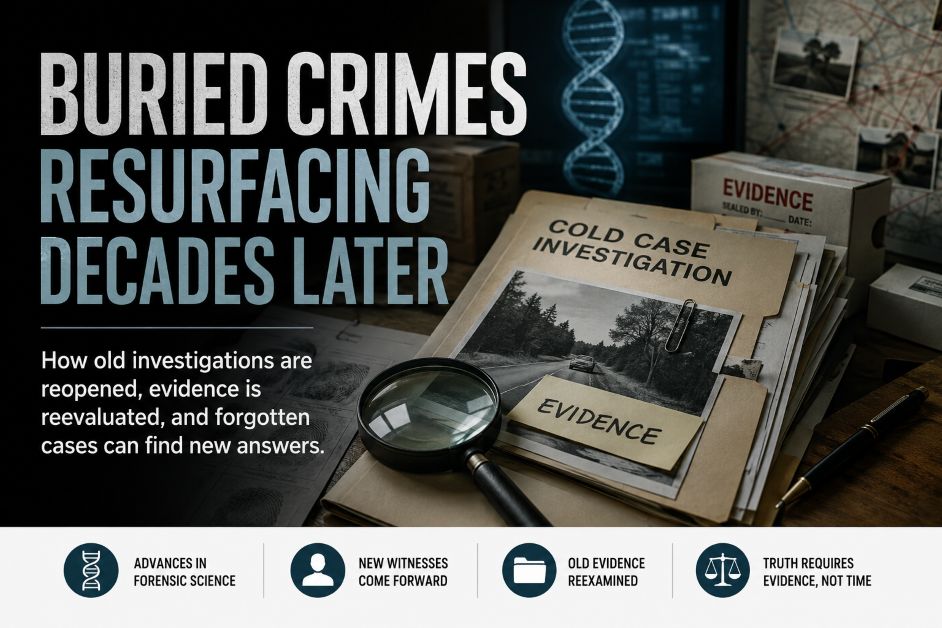
A crime can disappear from the headlines without disappearing from the evidence.
For families affected by buried crimes resurfacing decades later, the passage of time can make an old investigation feel like a chapter that was permanently closed. Yet advances in forensic science, new witnesses, improved databases, DNA analysis, and renewed investigative attention can sometimes bring decades-old crimes back into focus.
But why do old crimes resurface after so many years? How can investigators use evidence from decades-old crimes when witnesses have moved away, memories have changed, and physical evidence may have deteriorated?
Understanding cold case investigations requires more than fascination with unsolved mysteries. It requires looking at how investigators evaluate evidence, how technology changes what can be discovered, and why the psychological impact of an unresolved crime can remain long after the original investigation ends.
What Does “Buried Crimes Resurfacing Decades Later” Mean?
Buried crimes resurfacing decades later refers broadly to situations in which previously hidden, unresolved, forgotten, or unsolved crimes come back to public or investigative attention many years after they occurred.
A cold case is generally an investigation that has not been actively resolved because investigators lack sufficient evidence or viable leads. A case can remain open even when active investigation has slowed.
Why Can a Crime Stay Hidden for Decades?
There are many reasons long-forgotten crimes may remain unresolved:
- limited forensic technology
- missing or unreliable evidence
- witnesses who could not be identified
- incomplete records
- unidentified remains
- changes in investigative priorities
- insufficient information to identify a suspect
The absence of an immediate breakthrough does not necessarily mean investigators have stopped caring about a case.
Can a Resurfaced Crime Actually Be Solved?
Sometimes.
Cold cases solved decades later often become solvable because something changes. That change might involve new evidence in old cases, advances in technology, a new witness, a confession, or a connection that earlier investigators could not establish.
However, a new lead is not automatically proof. A responsible crime investigation years later still requires careful verification.
Why Do Old Crimes Resurface?
The reasons behind crimes resurfacing decades later are often connected to changes in technology, evidence, circumstances, or investigative attention.
New DNA Testing Reveals Old Answers
One of the most important developments in modern forensic investigation is the ability to obtain useful information from biological evidence that may have been collected years earlier.
Advances in DNA analysis can sometimes make previously unusable or inconclusive material more informative.
This means that decades-old DNA evidence can occasionally become relevant when investigators revisit an old case using newer methods.
Genetic Genealogy Can Reopen Cold Cases
Genetic genealogy has become another tool associated with certain cold case breakthroughs. At a broad level, investigators may use genetic information and genealogy databases to help identify potential relationships or investigative leads.
The technique does not automatically establish guilt. Instead, it can help generate a lead that investigators must independently evaluate.
Witnesses May Come Forward Years Later
Another reason old crimes coming to light is that someone who previously remained silent may eventually provide information.
Circumstances can change. A witness may become older, feel safer speaking, remember something differently, or learn information that changes how they understand an earlier event.
Investigators must still determine whether the information can be corroborated.
Old Evidence Gets a Second Look
Sometimes the breakthrough comes not from newly discovered evidence but from old evidence reexamined.
A new investigator may notice a connection that was previously overlooked. A database may now contain information that did not exist when the original investigation took place.
This demonstrates why reopening cold cases can be worthwhile even decades after the original crime.
How Forensic Science Helps Solve Decades-Old Crimes
Modern forensic science and cold cases are closely connected because technological improvements can change what investigators can learn from physical evidence.
DNA Evidence
Biological evidence may include material collected during the original investigation. Improved testing can sometimes provide information that earlier methods could not.
Fingerprint and Trace Evidence
Fingerprint evidence, fibers, particles, and other forms of trace evidence can potentially help establish connections between people, places, and objects.
Forensic Anthropology
Forensic anthropology can help investigators examine unidentified human remains and develop information about identity, age, biological characteristics, or circumstances surrounding death.
Digital Forensics
Modern investigations can also involve digital forensics. Electronic records, databases, communications, photographs, and other digital information may provide investigative context that was unavailable decades earlier.
The important point is that technology does not replace investigators. It gives them additional methods for evaluating crime scene evidence and connecting information.
Can Memories of a Crime Resurface After Decades?
This is one of the most complicated parts of old investigations.
People sometimes remember events years after they occurred. However, memory reliability is different from physical evidence.
Trauma and Memory Are Complicated
Trauma and memory can interact in complicated ways. Someone may remember an experience with intense emotion while still having uncertainty about particular details.
This does not mean a person’s experience should automatically be dismissed.
It means that investigators need to distinguish between someone’s recollection and independently verifiable evidence.
Recovered Memories Require Care
Discussions about recovered memories and crime can be particularly sensitive.
Research has raised concerns about memory distortion, suggestive questioning, and the possibility of false memories and evidence being confused with established facts.
For that reason, investigators should seek corroboration rather than treating a resurfaced memory as conclusive by itself.
Why Corroboration Matters
A responsible investigation may compare testimony with:
- physical evidence
- historical records
- timelines
- other witnesses
- forensic findings
- communications
- independent documentation
This helps separate a potentially valuable lead from an unsupported conclusion.
How Investigators Reopen a Cold Case
A renewed cold case investigation does not simply begin with a dramatic discovery. It usually involves methodical examination.
Step 1: A New Investigative Lead Emerges
A lead may involve DNA, a witness, a confession, an identification, or information discovered in another investigation.
Step 2: Existing Evidence Is Reexamined
Investigators review cold case evidence to determine whether previous findings can be interpreted differently using current knowledge.
Step 3: Independent Evidence Is Sought
Investigators attempt to corroborate witness accounts and other claims.
Step 4: The Timeline Is Reconstructed
A detailed crime investigation may involve examining locations, relationships, movements, communications, and other documented information.
Step 5: Prosecutors Evaluate the Evidence
An investigative breakthrough is not the same thing as a conviction.
A suspect can be identified while important questions remain unanswered. Evidence must meet applicable legal standards before criminal responsibility can be established.
Real Cold Cases Can Resurface in Unexpected Ways
The history of cold cases solved decades later demonstrates that there is no single formula for solving an old case.
Some investigations depend on DNA. Others involve genetic genealogy, previously overlooked interviews, confessions, or evidence discovered during unrelated investigations.
The important lesson is not simply that technology solves everything.
It is that investigative breakthroughs can occur when new information is combined with existing evidence.
A case that once appeared impossible may become more understandable when investigators have access to better forensic tools, larger databases, or information that was unavailable at the time of the original investigation.
Why Some Crimes Remain Buried Even After They Resurface
Not every reopened investigation results in an arrest or conviction.
Evidence May Be Lost or Degraded
Physical evidence can deteriorate or become unavailable.
Witnesses May Have Died
Decades can dramatically change an investigation. People who possessed important information may no longer be available.
Memories May Conflict
Different recollections can make an old investigation difficult to reconstruct.
Evidence May Not Meet the Legal Standard
An investigator may strongly suspect what happened without possessing enough evidence to prove it in court.
This distinction is essential when discussing unsolved murder cases or other unsolved crimes.
A person being investigated is not automatically guilty.
The Psychological Impact When a Buried Crime Resurfaces
The story does not end with forensic evidence.
For families, buried crimes resurfacing decades later can bring complicated emotions.
What It Can Mean for Victims’ Families
A reopened case may offer hope for answers, but it can also revive grief.
Families who have lived with uncertainty may suddenly have to revisit painful memories, media attention, interviews, and unanswered questions.
Closure Is Not Always Simple
The word “closure” is often used when discussing long-forgotten crimes, but answers do not necessarily erase decades of pain.
Learning what happened may provide understanding. It may also introduce difficult information that families were not prepared to hear.
Trauma Can Outlast the Investigation
The psychological impact of unresolved crime can continue across families and communities.
This is one reason responsible reporting should treat victims as people rather than simply as characters in a mystery.
How Investigators Separate Evidence From Speculation
One of the most important principles in a forensic investigation is distinguishing what is known from what is suspected.
Verify Before Drawing Conclusions
A compelling theory is still only a theory until evidence supports it.
Corroborate Witness Testimony
Witness statements can be valuable, but investigators should consider consistency, context, timing, and independent evidence.
Preserve the Chain of Evidence
Evidence preservation is essential because investigators and courts need confidence that physical evidence has been properly handled.
Distinguish Leads From Proven Facts
A new investigative lead can point investigators toward a possible answer. It does not necessarily establish what happened.
Avoid Treating Online Claims as Evidence
Social media discussions and online theories can generate tips, but online speculation should not be confused with verified forensic evidence in cold cases.
Why Technology Is Changing the Future of Cold Cases
Technology will likely continue influencing the solving cold cases.
Advances in DNA Analysis
Improved DNA technology may allow investigators to revisit evidence that previously produced limited information.
Better Investigative Databases
Expanded databases can make it easier to identify connections between records, people, locations, and cases.
Improved Identification of Unidentified Remains
Modern forensic techniques may provide new information about unidentified victims.
Digital Evidence Preservation
Digital records can sometimes provide information that was impossible to obtain when an investigation first began.
The future of cold-case investigation is therefore not simply about technology. It is about combining technology with careful human judgment.
What Buried Crimes Teach Us About Trauma, Memory, and Truth
The story of buried crimes resurfacing decades later ultimately raises questions beyond crime-solving.
It reminds us that memory and evidence are not interchangeable.
It shows why trauma should be treated with compassion while claims still require careful verification.
And it demonstrates why families may continue searching for answers long after a case disappears from the public eye.
For readers interested in stories that explore psychological trauma through fiction, a Psychological Thriller About Trauma can examine similar themes of memory, fear, hidden truths, and emotional consequences without confusing fictional storytelling with real criminal investigations.
Likewise, a Gothic Psychological Novel can use buried secrets and resurfacing memories as fictional devices to explore the psychological effects of the past.
These fictional forms can illuminate emotional themes, but real crimes require evidence, responsible reporting, and respect for victims.
How to Read Cold-Case Stories Responsibly
True-crime reporting can be compelling, but readers should approach cold case investigations carefully.
Separate Confirmed Facts From Allegations
Look for information supported by official records or credible reporting.
Be Careful With Unverified Online Claims
A viral theory is not necessarily an investigative finding.
Remember the People Behind the Headlines
Real victims and families can be affected by renewed public attention.
Avoid Turning Real Suffering Into Entertainment
Responsible storytelling can be informative without sensationalizing trauma.
This distinction is particularly important when discussing decades-old crimes involving living victims, surviving relatives, or people who have never been convicted.
Frequently Asked Questions About Buried Crimes Resurfacing Decades Later
Can a crime really be solved decades later?
Yes. Cold cases solved decades later can sometimes be resolved when new evidence, forensic advances, witness information, or investigative connections become available.
Why do cold cases get reopened?
Why cold cases are reopened varies by case, but common reasons include new DNA evidence, new witnesses, confessions, database matches, or a renewed review of existing evidence.
Can old DNA evidence still be useful?
Sometimes. The usefulness of decades-old DNA evidence depends on factors such as how the evidence was collected, preserved, and what testing methods are available.
Can a witness remember a crime decades later?
A witness may remember an event many years later, but memory reliability must be considered carefully. Independent corroboration can be particularly important.
What causes a buried crime to resurface?
Why old crimes resurface can involve new forensic discoveries, new witnesses, renewed publicity, database connections, confessions, or investigators revisiting old evidence.
How does genetic genealogy help cold cases?
Genetic genealogy cold cases may involve using genetic information to generate investigative leads. Such leads require additional investigation and corroboration.
Can a reopened case remain unsolved?
Yes. Reopening cold cases does not guarantee an arrest or conviction.
Are recovered memories always reliable?
No. Recovered memories and crime are a complex subject, and memories can be affected by time, suggestion, and other factors.
What is the difference between a lead and evidence?
A lead gives investigators a direction to investigate. Evidence is information that can be evaluated for its relevance and reliability in establishing what happened.
Why do some families wait decades for answers?
Investigations can remain unresolved because evidence is unavailable, witnesses cannot be located, identities remain unknown, or investigators lack sufficient information to establish what happened.
Final Thoughts: When the Past Refuses to Stay Buried
Buried crimes resurfacing decades later demonstrate that time does not always erase unanswered questions.
A forgotten piece of evidence may become meaningful. A new forensic technique may provide information that was impossible to obtain years earlier. A witness may finally come forward. A database may reveal a connection that investigators could not previously see.
But solving an old crime requires more than discovering a compelling clue.
It requires careful investigation, evidence preservation, corroboration, responsible use of forensic science, and respect for the difference between suspicion and proof.
For families, the resurfacing of a decades-old crime can bring both hope and renewed pain. For investigators, it can represent an opportunity to examine what was previously unknown. And for readers, these cases offer a reminder that the search for truth should always be balanced with compassion for the people who lived through the original events.
Sometimes the past stays quiet for decades.
Then one piece of evidence changes the question—and the investigation begins again.



0 Comments